
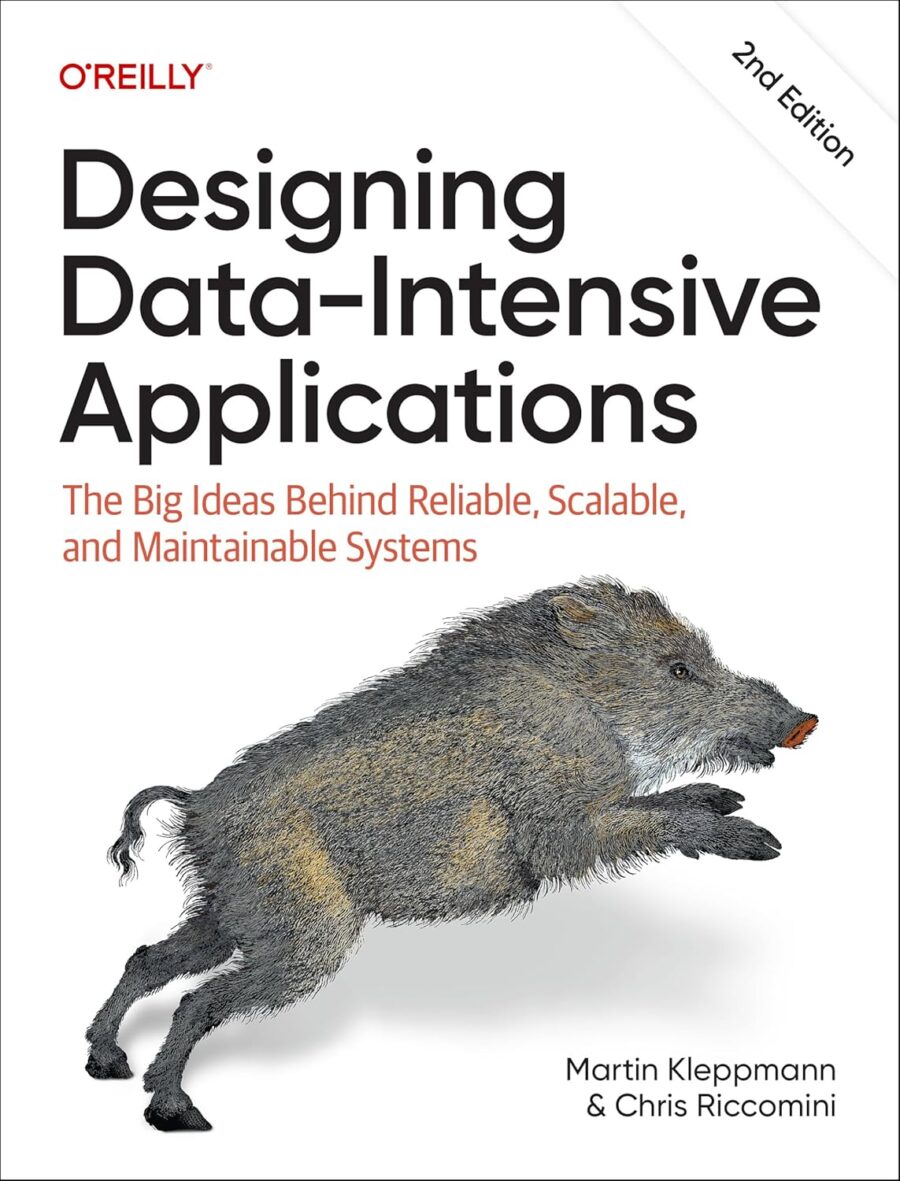
Most engineers learn distributed systems the hard way — by watching something break in production at 2 a.m. Designing Data-Intensive Applications exists so you don’t have to learn everything that way. Written by Martin Kleppmann.
The book has become one of the most recommended references for anyone building systems that store, move, or process data at scale. It doesn’t teach a framework or a language. Instead, it teaches the ideas underneath almost every database, queue, and distributed system you’ll ever touch.
.
Why “Reliable, Scalable, and Maintainable” Actually Means Something
The subtitle isn’t marketing fluff — it’s the book’s actual thesis. Kleppmann treats these three words as engineering requirements, not vague goals, and spends real effort defining what each one means in practice.
- Reliable — the system keeps working correctly even when hardware fails, software has bugs, or humans make mistakes
- Scalable — the system has reasonable ways to cope with growth in data, traffic, or complexity
- Maintainable — people other than the original author can work with the system productively over time
Most engineering books skip straight to implementation. This one insists you understand the tradeoffs first. Consequently, readers come away with a vocabulary for arguments they’ve probably already had in code review without knowing the right terms for them.
The Foundations: Data Models and Storage Engines
The first part of the book breaks down how data actually gets stored and queried underneath the abstractions most developers use daily. It covers relational, document, and graph data models side by side, explaining honestly where each one shines and where each one causes pain later.
From there, it goes into storage engines — how databases physically write and read data on disk. Topics include:
- Log-structured storage and how write-heavy systems like LSM-trees work
- B-trees and why most traditional relational databases still rely on them
- Column-oriented storage for analytical workloads
- The tradeoffs between OLTP and OLAP systems
This section alone changes how people think about database selection. Instead of “MySQL vs. MongoDB” debates, you start asking what your actual read and write patterns look like.
Designing Data-Intensive Applications for Distributed Reality
Once the book moves into distributed systems, the tone shifts from “here’s how things work” to “here’s why things go wrong.” This is where the book earns its reputation.
It walks through replication strategies — single-leader, multi-leader, and leaderless — and explains the failure modes each one creates. It doesn’t shy away from uncomfortable truths either. For instance, it makes clear that “eventual consistency” is a spectrum, not a guarantee, and that most teams misunderstand what their systems actually promise them.
Partitioning gets similar treatment. Splitting data across machines sounds simple until you have to handle:
- Rebalancing when nodes are added or removed
- Hot spots caused by uneven data distribution
- Routing requests to the correct partition without a single point of failure
Readers finish this section with a much healthier suspicion of any vendor claiming their database “just handles” distributed problems automatically.
Transactions, Consistency, and the Hard Parts Nobody Explains Well
This is arguably the strongest section of the book, and the one most engineers wish they’d read years earlier. Kleppmann untangles concepts that get thrown around constantly but rarely get properly defined — isolation levels, linearizability, causality, and consensus.
The explanation of why “ACID” means different things to different database vendors alone is worth the read. Many engineers assume transactional guarantees are standardized. They aren’t, and this book shows exactly where the gaps hide.
Consensus algorithms like Paxos and Raft also get covered here, not as academic trivia but as the actual mechanism behind leader election in systems people use every day. Understanding this section makes debugging distributed failures dramatically less mysterious.
Batch and Stream Processing: Where Data Actually Moves
The final major section covers how data flows through systems over time — batch processing frameworks, stream processing, and the increasingly blurry line between the two. It explains why companies built entire architectures like the Lambda and Kappa patterns, and where those patterns eventually broke down in practice.
This part of the book ages particularly well because the underlying problems — reprocessing historical data, handling out-of-order events, keeping derived data in sync with source data — haven’t gone away even as specific tools have changed.
Conclusion
Plenty of technical books go stale within a few years. This one hasn’t, mostly because it teaches principles instead of product documentation. A team choosing between Kafka and Kinesis, or Postgres and Cassandra, will get more lasting value from this book’s frameworks than from either vendor’s marketing page.
If you build systems that handle real data at real scale — or you want to understand why the systems you already run behave the way they do — this is one of the few technical books worth reading cover to cover rather than skimming for reference.
Also read: Designing Machine Learning Systems